

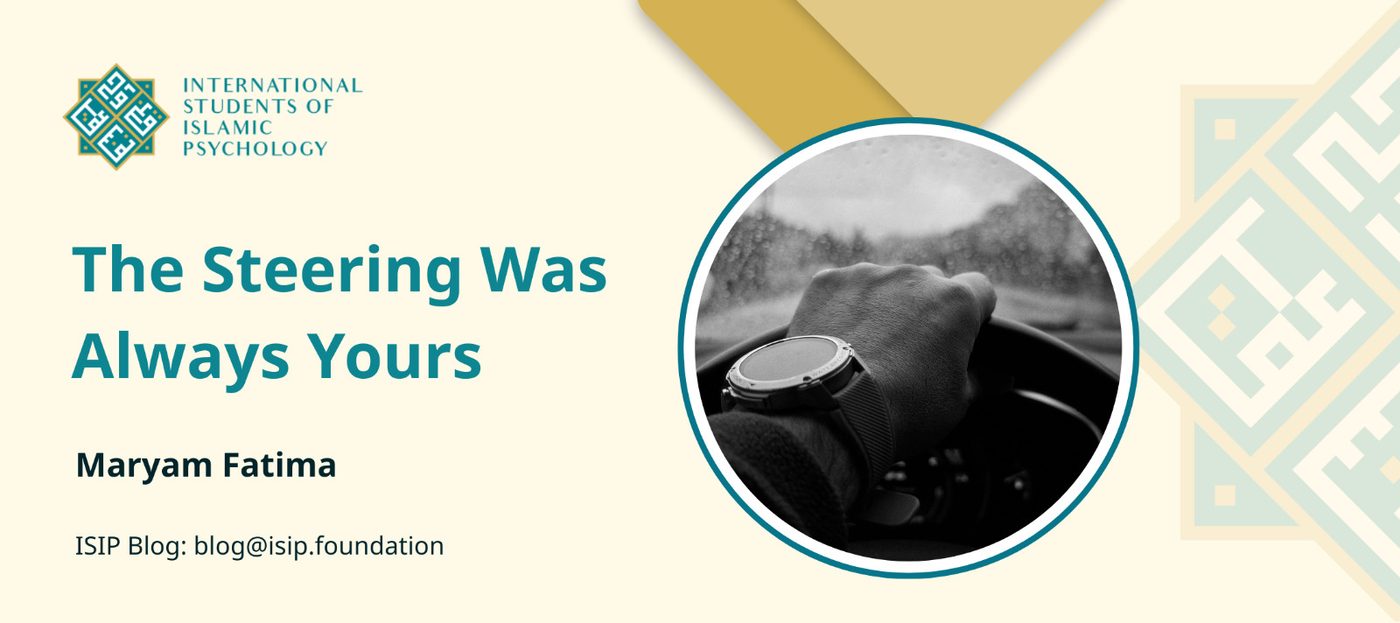
You move not because you are certain of arrival, but because you are certain of Him.
- The Glance and the Grip
There are days when looking back feels like the only honest thing. The rear-view mirror is not always avoidance. Sometimes it is cartography: you are trying to understand the terrain so the road ahead makes sense. But there is a moment, and you will know it when it comes, when the mirror becomes the whole view. When the glance becomes a gaze. When the gaze becomes a grip.
Someone I look up to, someone whose presence taught me what it means to truly listen, said something recently that I have not been able to set down. He said: use the rear-view mirror to learn from what’s behind you, but keep your hands on the steering wheel and your eyes on the road ahead.
Not a lesson. A recognition. Something in me loosened when I heard it. Not the loosening of relief, something else. As if a fist I had forgotten I was making, slowly opened, and there in the palm, was something I had not lost at all.
- The Wound and the Light
Rumi raḥimullāh said: the wound is where the light enters you.
You have been treating the wound as evidence of failure. It is not. It is the opening.
There is a difference between being broken and being broken open, and the difference is not visible from inside the breaking. It only becomes clear later, in the looking. The nafs that stumbles is not the nafs that is abandoned. The qalb that aches is not the qalb that has been forsaken. That reproach you feel, the turning on yourself, the quiet indictment, Islam has a name for it: nafs al-lawwāmah, the self-reproaching soul. The Qurʾān names it not to condemn it but to recognise it. A soul that still notices its own stumbling has not stopped caring.
Waswasā circles the qalb like smoke. It does not announce itself. It arrives as a reasonable-sounding thought: this is just how things are. You have always been this way. What makes you think anything changes? And the mind, worn and willing, begins to agree. Rumination is waswasā given permission to settle. It is the thought you turned over once becoming the thought you cannot put down.
The antidote is not argument. You cannot reason your way out of waswasā. The antidote is dhikr. A turning, not a refuting. “Alā bi-dhikrillāhi taṭmaʾinnu al-qulūb” — truly, in the remembrance of Allah do hearts find rest (13:28, al-Qur’an).
Not one day. This day. This breath. “Fa-inna maʾa al-ʿusri yusrā” — with hardship comes ease (94:5, al-Qur’an). It was said twice in the same breath. Not for emphasis. For certainty.
- Those Who Moved Before You
You are not the first person to stand at the edge of forward and hesitate.
Consider Yaʿqūb ʿalayhi as-salām, a father who wept until his sight was veiled, who held grief in one hand and certainty in the other, and did not let go of either. His sorrow was not weakness; it was proof the rope had not been let go. And yet he moved. He sent his sons again. He said: “lā tay’asū min rawḥillāh” — do not despair of Allah’s mercy (12:87, al-Qur’an). Grief and movement were not opposites for him. They were companions.
And from that companionship, Mūsā ʿalayhi as-salām came to a sea with no crossing. Those around him said they were overtaken. He said: “inna maʿiya rabbī sa-yahdīn” — my Lord is with me; He will guide me (26:62, al-Qur’an). He raised the staff. The water divided not before the standing but because of it.
The Hijrah carried this same truth forward: the Prophet Muhammad ﷺ and those who loved him, left behind everything the word “home” had ever meant. Not because it was easy, but because forward was the only direction a faithful heart could travel.
Three moments. One unbroken lesson. You move not because you are certain of arrival, but because you are certain of Him.
Maryam ʿalayhi as-salām knew this in her body. Alone, in pain, she was told: “ḥuzzī ilayki bi-jidʿi an-nakhlah” — shake the trunk of the palm tree (19:25, al-Qur’an). She was not passive. She was not waiting for dates to fall. She reached. She shook. And the provision came, but only because her hand had moved first.
Hājar ʿalayhi as-salām was left in a valley with nothing. No water, no one in sight. She ran between Ṣafā and Marwah, back and forth, seven times. Not because she could see the water. Because she could not sit still while her child needed it. Zamzam came. And every pilgrim since has retraced those same steps; her movement became an act of worship for all of time.
The tree will not shake itself. The water will not spring out on its own. The steering wheel will not turn itself.
You have been waiting for a feeling of readiness that will not come before the movement. It comes during. The hand on the wheel does not wait for certainty. It moves.
- The Prayer You Write
There are people in your life who are sunshine. Not in the soft, metaphorical sense alone, but in the sense that nūr reaches you through them, despite the clouds you have arranged above yourself. They do not remove the clouds. They simply carry more light than clouds can block. What they illuminate is possibility. What you do with that possibility is still yours: the prayer you write, the direction you choose, even when everything around you seems to have already written it for you.
Āsiyah ʿalayhi as-salām was married to the most cruel man on earth, and she asked not for power but for proximity: “rabbanā ibni lī ʿindaka baytan fī al-jannah” — build for me, near You, a home in paradise (66:11, al-Qur’an). Her Qadar was not what anyone would have chosen. But she chose what she asked of it. She did not let the circumstances write the prayer. She wrote the prayer herself.
Ibrāhīm ʿalayhi as-salām was thrown into a fire he did not light; and what he chose within it was “ḥasbi Allāh wa niʿma al-wakīl” — Sufficient for me is Allah. The fire became cool. Not before choosing. Because of it. Something had to be applied. Something had to be chosen.
This is what Qadar as liberation looks like from the inside: not the erasure of difficulty, but the discovery that difficulty does not have the final word. That you are not authored by what happened to you.
- Eyes On The Road
Some people hold up a mirror and call it help. A mirror only shows what is. What you have been given is not a mirror, it is nūr, light that illuminates not to expose but to guide. Allah places nūr in your path in forms you do not always name immediately. Sometimes it arrives as a person, as presence, as a question asked at the right moment, as a reminder that the wheel is still in your hands.
You already know the difference between rumination and remembrance. Between turning the wound over and turning towards Allah. Between the rear-view mirror as a prison and the rear-view mirror as a map you are done consulting.
You have consulted it long enough. What remains, when the mirror is finally set down, is not emptiness. It is space for something else to be heard.
“Mā waddaʿaka rabbuka wa mā qalā” — your Lord has not abandoned you, nor does He despise you (93:03, al-Qur’an).
That was not said to a stranger. It was said to someone who had gone quiet, who felt the revelation pause, who wondered whether the silence meant absence. It was said into that exact ache.
It is being said now, into yours.
- The Return
Iqbāl raḥimullāh wrote: “tū shahīn hai, parwāz hai kām terā, tere sāmne āsmān aur bhī hain” — You are a shaheen (falcon), and flight is your purpose. Before you, lie yet more skies.
The shaheen does not nest on low branches. Not out of arrogance, but because height is necessary. Because from low ground, the horizon is invisible. Because some distances can only be seen from altitude. And because every sky you reach reveals another beyond it.
You have been low. It was necessary.
I remember the same person saying it once, in a different conversation: I am arriving. Indeed, arriving is not a place you reach and stay. Life keeps moving, forward and back, inward and out again. You arrive, and then something shifts, and you find yourself at the edge of arriving all over again. Not because you have lost ground. Because that is simply what a life in motion looks like. The journey does not end at a destination. It ends, if it ends at all, in the One you were always moving towards.
The nafs al-muṭmaʾinnah is not a destination you arrive at once and stay. It is a returning, again and again, to the One who settled you the last time and will settle you the next. “Yā ayyatuhā an-nafs al-muṭmaʾinnah, irjiʿī ilā rabbiki rāḍiyatan marḍiyyah” — O soul at rest, return to your Lord, well-pleased and well-pleasing (89:27-28 , al-Qur’an).
The return is not defeat. The return is the whole point.
You are not behind. You are not broken. You are not steering a vehicle whose direction has been decided without you. The road ahead is not entirely visible till the end, and that is not a threat. It is the most generous thing.
The steering was always yours. Go.
Article written by: Maryam Fatima, Author of But We Know — A Potpourri of Poetry
Such deep and meaningful words. Truly inspiring and motivating, they give you a lot to think about.